
Key takeaways

IEC 61850 is an international standard for substation automation that defines communication protocols enabling interoperability between protection relays, IEDs, merging units, and SCADA systems in digital substations. HSR (High-availability Seamless Redundancy, IEC 62439-3) and PRP (Parallel Redundancy Protocol, IEC 62439-3) are the two zero-recovery-time network redundancy protocols most widely adopted in IEC 61850 deployments.

  • IEC 61850 digital substations rely on process bus and station bus networks for protection, control, and monitoring.
  • HSR and PRP provide seamless redundancy for substation communications, supporting high network availability in different deployment scenarios.
  • ORing RGS-PR9000, RGS-P9000, and IGS-P9084GPI industrial Ethernet switches deliver IEC 61850-3-certified, HSR/PRP-capable switching for utility-grade infrastructure.

This guide covers the design and deployment of IEC 61850-compliant substation communication networks using HSR and PRP redundancy architectures, as defined in IEC 62439-3 (2016 edition). It addresses process bus and station bus network design, redundancy strategy selection, cybersecurity requirements under IEC 62443-4-2 (2019 edition) and IEC 62351-6, and the deployment of ORing industrial Ethernet switches — including the RGS-PR9000, RGS-P9000, and IGS-P9084GPI (all rated -40 to 75°C, IEC 61850-3 certified) — in modern digital substation environments. Intended for protection engineers, substation automation specialists, and network architects working on utility-grade communication infrastructure.
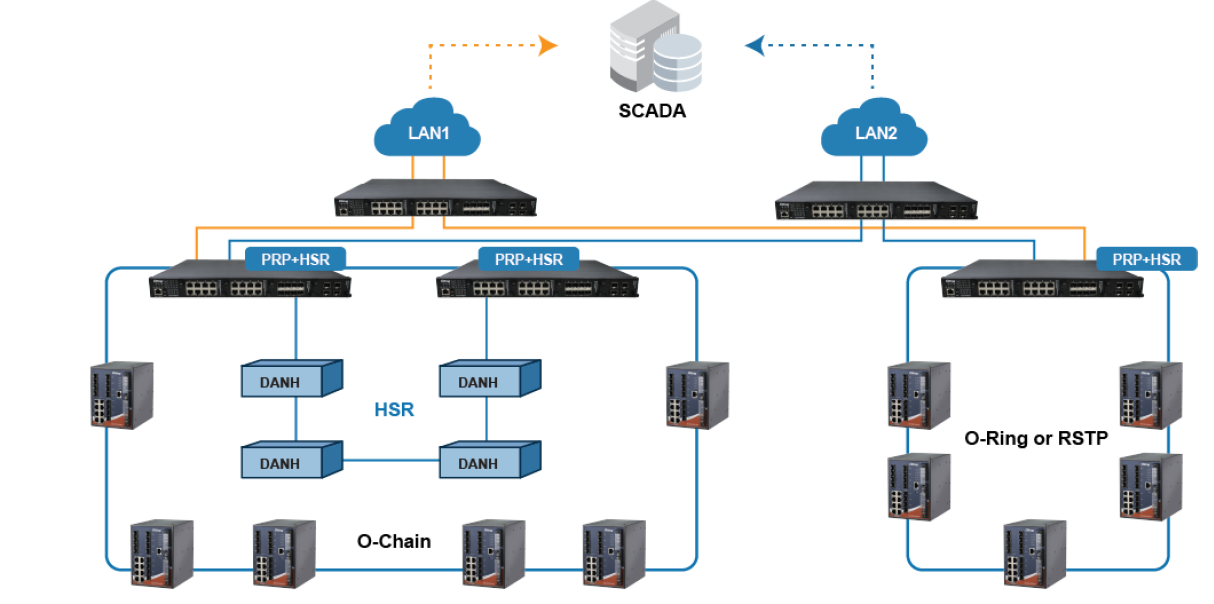
IEC 61850 substation network architecture diagram showing HSR ring topology at bay level connecting protection relays and IEDs, with PRP dual-network at station bus level, deployed using ORing industrial Ethernet switches

What is IEC 61850 and how does digital substation architecture work?

IEC 61850 is an international standard (IEC TC57) that defines a unified communication model for substation automation, enabling interoperability between protection relays, intelligent electronic devices (IEDs), SCADA platforms, and monitoring systems from different vendors. Digital substations built on IEC 61850 replace conventional copper wiring with two Ethernet-based network layers:

  • Process bus — transports sampled values (SV) and GOOSE protection messaging between merging units, protection relays, and field devices at the bay level.
  • Station bus — connects protection relays, gateways, engineering workstations, and SCADA systems across the substation control network.

How does HSR (High-availability Seamless Redundancy) work in IEC 61850 substations?

HSR (High-availability Seamless Redundancy) is a Layer-2 network redundancy protocol defined in IEC 62439-3 that creates ring-based topologies where each node simultaneously forwards frames clockwise and counter-clockwise. The destination node accepts the first copy to arrive and discards the duplicate, delivering zero recovery time for any single link failure.

  • Zero recovery time for network failures — no spanning tree convergence delay
  • Ring topology connecting protection relays and IEDs at bay level
  • Recommended for process bus networks with up to 50 nodes (IEC 62439-3 guideline)
  • No spanning tree protocols required

How does PRP (Parallel Redundancy Protocol) work in IEC 61850 substations?

PRP (Parallel Redundancy Protocol), also defined in IEC 62439-3, attaches each sending device to two fully independent Ethernet networks (LAN-A and LAN-B) simultaneously. Duplicate frames travel both paths; the receiver accepts whichever arrives first and silently discards the second, achieving zero switchover time even if an entire LAN fails.

  • Two fully independent LAN networks (LAN-A and LAN-B) with separate cabling
  • Zero switchover time — no reconfiguration required on failure
  • Ideal for station bus and control networks where dual cabling paths are available
  • Supports integration with non-PRP devices via RedBox (Redundancy Box) bridges

What should engineers consider when designing an IEC 61850 substation network?

A well-designed IEC 61850 network separates time-critical protection traffic from management and control traffic, and matches the redundancy architecture to the network layer:

  • Define clear physical and logical separation between process bus and station bus networks.
  • Deploy redundant core switching infrastructure for SCADA and station control systems using managed Layer 3 switches.
  • Use HSR rings for bay-level protection relay communication where deterministic, zero-recovery-time failover is required.
  • Use PRP dual-LAN architectures for station-level networks where separate cabling paths are available and extremely high availability is required.
  • Segment networks using VLANs and Layer 3 routing to isolate GOOSE domains, improve security, and reduce broadcast traffic.

How should cybersecurity be addressed in IEC 61850 digital substations?

Substation communication networks must align with both the IEC 62443 industrial cybersecurity framework and the IEC 62351 series for power system communication security. Key standards applicable to substation networks include:

  • IEC 62351-6 (2020 edition) — authentication for GOOSE and sampled values messages on the process bus.
  • IEC 62443-3-3 (2013 edition) — system-level security requirements and security levels for industrial automation systems.
  • IEC 62443-4-2 (2019 edition) — component-level security requirements for network devices including switches and gateways.

Recommended network-level practices include VLAN-based segmentation, IEEE 802.1X port authentication, encrypted management (SNMPv3, SSH), secure remote access via VPN, and centralized syslog monitoring for anomaly detection.

Which ORing switches are suitable for IEC 61850 digital substations?

ORing industrial Ethernet switches certified to IEC 61850-3 and IEEE 1613 provide the rugged hardware, HSR/PRP redundancy, and advanced management features required for utility-grade substation automation networks. Recommended models for IEC 61850 HSR/PRP deployments:

  • RGS-PR9000 — 19-inch rack-mount, Layer 3 managed, full HSR/PRP support, IEC 61850-3 certified, -40 to 75°C operating range. Suited for station bus backbone and high-density core switching.
  • RGS-P9000 — Layer 3 managed with HSR/PRP, IEC 61850-3 certified, -40 to 75°C. Suited for station bus and redundant backbone applications.
  • IGS-P9084GPI — 8-port compact DIN-rail, HSR/PRP support, IEC 61850-3 compliant, -40 to 75°C. Suited for bay-level field cabinet and distributed substation deployments.

All three models support centralized monitoring and configuration via Open Vision Pro network management software.

Frequently asked questions

1. Which ORing switches support HSR and PRP in IEC 61850 digital substations?

The RGS-PR9000, RGS-P9000, and IGS-P9084GPI all support HSR and PRP per IEC 62439-3. All three are IEC 61850-3 certified, operate at -40 to 75°C, and meet IEEE 1613 substation environmental requirements. The RGS-PR9000 and RGS-P9000 are 19-inch rack-mount Layer 3 switches suited for station bus roles; the IGS-P9084GPI is a compact 8-port DIN-rail switch suited for bay-level field cabinet deployment.

2. What is the difference between HSR and PRP in substation networks?

HSR uses a single ring where each frame travels both directions simultaneously; PRP uses two parallel independent LANs carrying identical frames at the same time. Both deliver zero recovery time, but the topology requirements differ: HSR needs only a single ring cable run (lower cabling cost, recommended for up to 50 nodes per IEC 62439-3), while PRP requires two separate cabling paths but scales better for larger station bus deployments and tolerates full LAN failures rather than just single link failures.

3. Which ORing model is suitable for IEC 61850 HSR or PRP deployment?

Choose based on installation location and network role. For station bus backbone or high-density core switching, the RGS-PR9000 or RGS-P9000 (both Layer 3, 19-inch rack-mount, -40 to 75°C) are the recommended options. For bay-level field cabinets or distributed substation nodes where DIN-rail mounting and compact footprint are required, the IGS-P9084GPI (8-port, DIN-rail, -40 to 75°C) provides full HSR/PRP support in a smaller form factor.

4. Can ORing RGS-PR9000, RGS-P9000, and IGS-P9084GPI be used in IEC 61850 substations?

Yes. All three models are certified to IEC 61850-3, comply with IEEE 1613 for substation environments, support HSR/PRP redundancy per IEC 62439-3, and operate across the full -40 to 75°C temperature range. They are designed for communication paths involving protection relays, IEDs, merging units, gateways, and SCADA systems in both process bus and station bus roles.

5. Why are HSR and PRP important in digital substations?

Substation protection functions — such as GOOSE-based tripping commands — have latency budgets as tight as 4 ms (IEC 61850-5 performance class P2/P3). A conventional network with spanning tree recovery (typically 1-30 seconds) would miss these timing requirements entirely during a link failure. HSR and PRP pre-deliver duplicate frames on redundant paths so there is no recovery interval at all — the network continues without interruption when any single link or LAN fails.

6. How do ORing switches help improve cybersecurity in substations?

ORing switches support IEC 62443-4-2 (2019 edition) component-level security requirements through IEEE 802.1X port-based access control, VLAN segmentation, SNMPv3 encrypted management, SSH, role-based access control (RBAC), and syslog-based audit logging. When deployed alongside IEC 62351-6-compliant IEDs for GOOSE authentication, models such as the RGS-PR9000, RGS-P9000, and IGS-P9084GPI help form a defence-in-depth substation network architecture aligned with both IEC 62443 and IEC 62351.

7. What should engineers consider when choosing between RGS-PR9000, RGS-P9000, and IGS-P9084GPI?

Compare four factors: (1) Form factor — 19-inch rack (RGS models) vs DIN-rail compact (IGS-P9084GPI); (2) Port density — number and type of ports required at each substation node; (3) Routing requirements — Layer 3 inter-VLAN routing is available on RGS models; (4) Network role — station bus backbone vs bay-level field cabinet. Contact ORing technical support for a topology-specific recommendation.

Related resources