
Project Introduction
Location: Belgium
Project Name: ORing Partners with Belgian Public Transport Operator to Build a Next-Generation IP-Based Onboard Communication Architecture
As intelligent systems such as real-time positioning, passenger information displays, onboard video surveillance, and passenger flow analytics continue to be deployed, previously fragmented and independent onboard communication systems gradually became an operational bottleneck. At the same time, the existing communication environment, largely based on 3G technology, was approaching obsolescence, prompting the operator to redesign its onboard communications infrastructure.
To improve operational efficiency and passenger service quality across its bus and tram fleets, Belgian public transport operator De Lijn launched the “IT on Board” program to modernize its onboard IT architecture.
Based on the ITxPT standard, De Lijn established a unified IP architecture that enables all onboard devices to interconnect through a single IP network while sharing core services such as time synchronization and GNSS positioning. To build a forward-looking and scalable onboard network environment, De Lijn selected ORing Industrial Networking’s industrial-grade 5G onboard communication solution as the communications platform for its bus and tram IT architecture.
Project Requirement
- A unified onboard IP communication architecture compliant with ITxPT standards
- 5G connectivity to replace the existing 3G network
- Reliable and stable connectivity for buses and trams during operation
- Centralized device monitoring to improve fleet maintenance efficiency
Solution
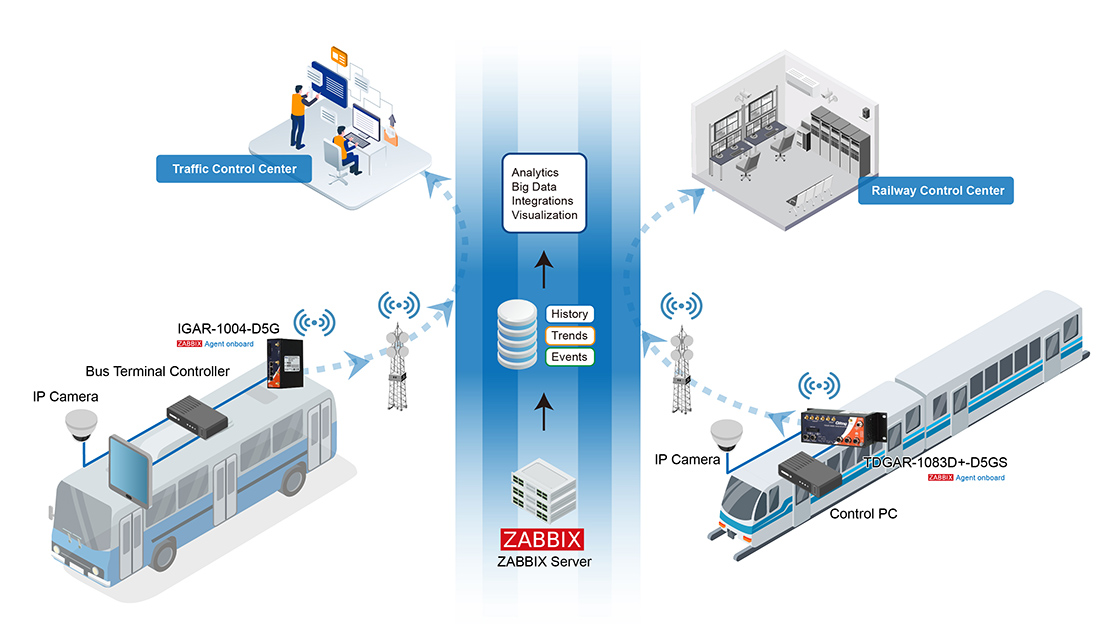
For the bus fleet, De Lijn deployed the ORing IGAR-1004-D5G 5G vehicle router. The device complies with the ECE R10 automotive EMC standard and supports dual-mode 5G and LTE connectivity. With multiple WAN interfaces, it can integrate various onboard systems within a single network. Its dual-SIM redundancy mechanism ensures stable connectivity even when cellular network conditions fluctuate, allowing vehicle positioning and operational data to be transmitted to backend systems in real time.
For trams, an industrial-grade 5G cellular router compliant with the EN50155 railway standard was adopted. Featuring M12 connectors, the device is designed to operate reliably in vibration-prone and harsh environments. It also supports dual-mode 5G and LTE connectivity as well as dual-SIM redundancy, ensuring uninterrupted transmission of train operation and positioning data.
In addition, ORing’s onboard devices include a built-in Zabbix Agent and integrate with a backend Zabbix monitoring platform to establish a centralized device monitoring and asset management system. Through the scalable and flexible open-source monitoring architecture, operators can monitor the online status, firmware versions, last known locations, and abnormal events of all communication modules in real time, significantly improving fleet maintenance efficiency.
Through real-time data exchange between vehicles and the backend operations center, operational information, vehicle status, and passenger-related data can be transmitted rapidly to backend systems, forming a key foundation for improving service punctuality, optimizing dispatch management, and enhancing passenger experience.
System Structure
Why ORing
- Industrial-grade 5G onboard communication devices for continuous operation
- Dual-mode 5G/LTE with dual-SIM redundancy for stable connectivity
- Compliant with ECE R10 and EN50155 transportation standards
- ITxPT support with integrated Zabbix monitoring platform