
How to Choose an Industrial Ethernet Switch: A Selection Guide
Choosing an industrial Ethernet switch is about matching the switch tier to the topology, recovery requirements, segmentation needs, and operating environment — not simply finding the model with the longest feature list. A small machine cell may need only robust plug-and-play connectivity, while a plant backbone may require VLANs, routing, redundancy, and centralized monitoring.
1. Four Switch Tiers at a Glance
| Tier | Management | Redundancy | VLAN / QoS | Routing | Typical Deployment |
|---|---|---|---|---|---|
| Unmanaged | None | Physical design dependent | No | No | Small machine cells, edge connections |
| Layer 2 Managed | Full L2 | RSTP/MSTP/MRP/proprietary | Yes | No | Segmented plant networks, managed aggregation |
| Layer 3 Managed | Advanced L2/L3 | Advanced redundancy | Yes | Yes | Large plants, substations, routed OT zones |
Start with the minimum control level required to keep the network available and maintainable. Buying a fully managed switch for every edge device adds unnecessary overhead; choosing an unmanaged switch for a network that needs segmentation or fast recovery can create operational risk.
2. Start with Three Questions
How many nodes are in the network?
For a small isolated cell, port count and physical robustness may matter more than advanced software. As devices, uplinks, VLANs, and cabinets multiply, managed visibility becomes more valuable because troubleshooting by physical inspection no longer scales.
Do you need ring redundancy?

If a single cable or device failure can stop production, use a topology and switch class that support the required redundancy method. ORing's managed portfolio includes models supporting industrial ring technologies; supported protocols and recovery behavior vary by model.
Do you need to route between subnets?
Routing is the clearest dividing line between Layer 2 and Layer 3. If traffic must move between multiple IP subnets — production cells, cameras, engineering workstations, control systems — a Layer 3 industrial switch can reduce dependence on an external router.
3. When Unmanaged Is Enough — and When It Is Not
Unmanaged switches fit applications where the network is intentionally simple: PLCs, sensors, HMIs, cameras, or controllers in a stable topology with no need for VLAN configuration or remote diagnostics. Their advantage is operational simplicity: install, power, connect.
They stop being the best fit when the network becomes difficult to observe or when downtime carries a meaningful production cost. If operators need event logs, VLANs, port monitoring, redundancy control, or remote troubleshooting, a managed tier becomes easier to justify.
4. Layer 2/3 Managed: Segmentation, Routing and OT Security
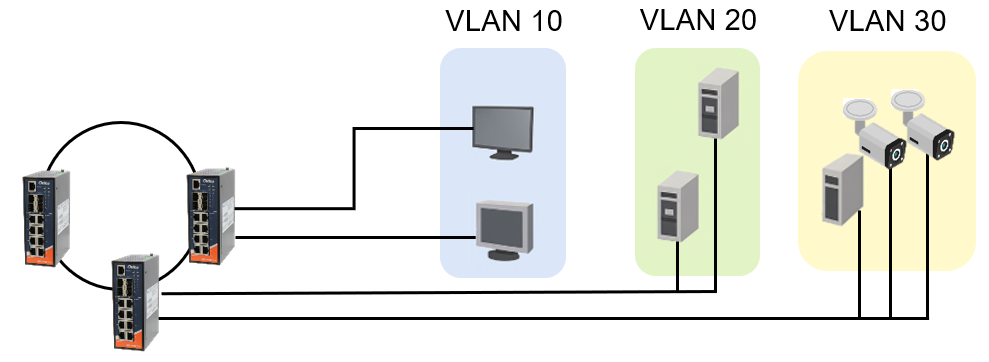
Layer 2 managed switches are the standard choice when deterministic segmentation and observability matter. VLANs separate production, maintenance, video, and management traffic; QoS protects time-sensitive flows. Layer 3 models add routing between subnets and help create clearer OT zones. Exact IEC 62443-4-2 certification must be verified at product level before being used as a procurement requirement.
5. Environmental and Certification Checklist
| Requirement | When It Matters | What to Check |
|---|---|---|
| Wide operating temperature | Outdoor cabinets, unconditioned plants, rail/roadside | Rated range, derating, airflow |
| Redundant power input | Processes where a single power failure is unacceptable | Input range, dual feed, alarms |
| IEC 61850-3 / IEEE 1613 | Power substations and utility environments | Exact certification and environmental class |
| EN 50155 | Onboard railway equipment | Temperature class, shock/vibration, connector type |
| NEMA TS2 | Roadside/traffic-control deployments | Exact product certification |
| IEC 62443-4-2 | OT cybersecurity procurement | Certified component security requirements |
6. A Practical Selection Sequence
- ✓Map the topology: node count, uplinks, fiber runs, cabinets, and required port speeds
- ✓Classify downtime risk: decide whether link or device failure must recover automatically
- ✓Define segmentation: list VLANs, management zones, and any inter-subnet routing requirements
- ✓List environmental constraints: temperature, vibration, EMC, mounting, power input, and enclosure needs
- ✓Translate compliance needs into model-level requirements rather than brand-level assumptions
- ✓Choose the simplest tier that meets the operational requirement, then compare port count, fiber options, PoE and management features