
Choosing an Industrial Ethernet Switch by Application
Industrial Ethernet switch selection changes with the application. The switch that fits a clean factory cabinet may be wrong for a substation, a train, a roadside enclosure, or a surveillance network. The most reliable way to specify a switch is to begin with the operating environment and traffic, then translate those conditions into redundancy, certification, connector, PoE, management and security requirements.
1. Why Application Drives the Specification
Port count is only one line in an industrial network specification. Application context determines which failures are likely, how quickly the network must recover, whether traffic must be segmented, what environmental tests matter, and which standards must be documented.
2. Factory Automation
Factory networks connect PLCs, HMIs, drives, machine controllers, robots, vision systems, sensors and edge computers. Selection normally focuses on stable Ethernet operation, manageable segmentation, redundancy for critical cells, and compatibility with industrial protocols such as PROFINET or EtherNet/IP where required.
For a small machine cell, an unmanaged or lite-managed switch may be sufficient. For a plant backbone, managed Layer 2 or Layer 3 functions become more useful — VLANs, diagnostics, routing and centralized management reduce troubleshooting time. ORing's factory automation portfolio also includes a 10BASE-T1L SPE switch for connecting next-generation field devices over long single-pair copper runs.
3. Substation and Power Utilities
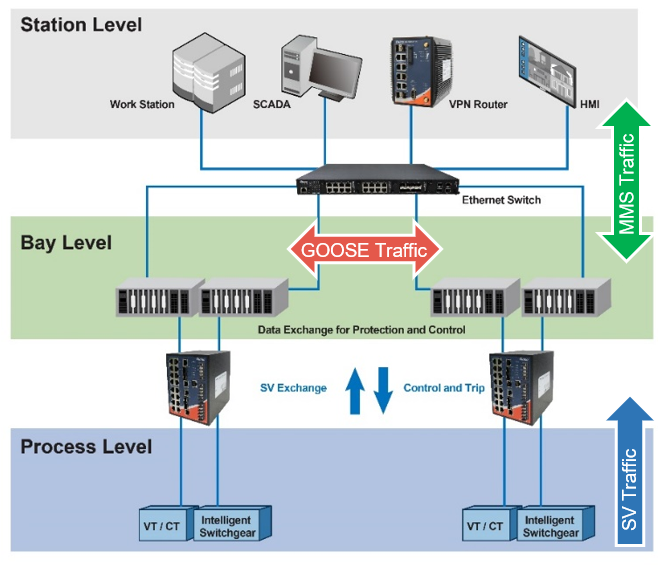
Substations require high availability and resilience in electrically demanding environments. IEC 61850 networks can carry GOOSE, sampled values and MMS traffic, and the network design must protect time-critical communications from avoidable interruption.
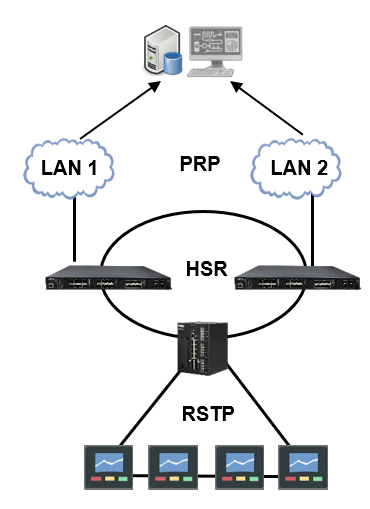
Where zero switchover is required, HSR/PRP architectures may be used rather than relying only on a conventional ring recovery process. ORing offers IEC 61850-oriented products and HSR/PRP solutions; exact compliance and feature support should be verified at model level.
4. Railway
Onboard
Onboard railway equipment must handle vibration, shock, temperature variation and constrained installation space. EN 50155 compliance and secure connectors such as M12 are common selection factors for rolling stock. PoE can also simplify camera and passenger-information installations by combining data and power.
Trackside
Trackside networks may prioritize long-distance fiber links, cabinet temperature range, redundant power and remote monitoring. The requirements are different from onboard equipment, so "railway switch" should never be treated as one generic specification.
5. Roadside and Intelligent Transportation Systems
Traffic control cabinets, roadside cameras, signs and intersection systems operate in outdoor conditions and may experience heat, cold, surge events and difficult maintenance access. Selection should check NEMA TS2 or other project-specific compliance, wide-temperature operation, PoE where field devices require power, and remote diagnostics that allow operators to identify faults without opening every cabinet.
6. IP Surveillance
Surveillance networks are defined by bandwidth and power as much as by port count. High-resolution cameras, PTZ motors, heaters and IR illuminators can create significant PoE demand. The switch must be sized for both per-port power and total power budget, while uplink capacity must handle aggregate video traffic.
Managed PoE features can improve operations: PD status checking, power scheduling, or port control help recover cameras remotely and reduce unnecessary site visits.
7. Application-to-Specification Table
| Application | Key Requirement | Typical Certification / Standard | Suggested Tier |
|---|---|---|---|
| Factory automation | VLAN, redundancy, protocol compatibility | PROFINET / project-specific OT security | Lite-Managed to L3 |
| Substation / utility | High availability, EMC resilience, deterministic protection traffic | IEC 61850-3, IEEE 1613; HSR/PRP where required | Managed L2/L3 |
| Railway onboard | Vibration, shock, locking connectors, PoE | EN 50155; project-specific railway standards | Managed / application-specific |
| Roadside / ITS | Outdoor environment, surge, remote diagnostics, PoE | NEMA TS2 where specified | Unmanaged to Managed PoE |
| IP surveillance | PoE budget, uplink bandwidth, remote power management | IEEE 802.3af/at/bt by endpoint need | PoE Managed |
8. How to Convert an Application into a Switch Specification
- Write down the devices and traffic types before selecting the switch
- Define the environmental envelope: cabinet, onboard, outdoor, substation, plant floor or control room
- Specify acceptable downtime and choose the redundancy architecture accordingly
- Calculate copper, fiber and PoE needs, including future expansion
- List mandatory certifications and require model-level evidence
- Define management and security functions only after physical and availability requirements are clear