
Industrial vs Commercial Ethernet Switch: What Actually Differs
The short answer: an industrial Ethernet switch is built for environments and failure conditions that a typical office switch is not designed to handle. The difference is not simply a metal enclosure — it is the combination of environmental tolerance, power architecture, mounting, EMC resilience, redundancy functions, lifecycle expectations, and application-specific certification.
1. The Short Answer
A commercial Ethernet switch is usually optimized for climate-controlled rooms, stable AC power, and low mechanical stress. An industrial switch is intended for cabinets, production floors, substations, vehicles, roadside systems, and other locations where temperature, vibration, electrical noise, or maintenance access can be more demanding.
2. Side-by-Side Comparison

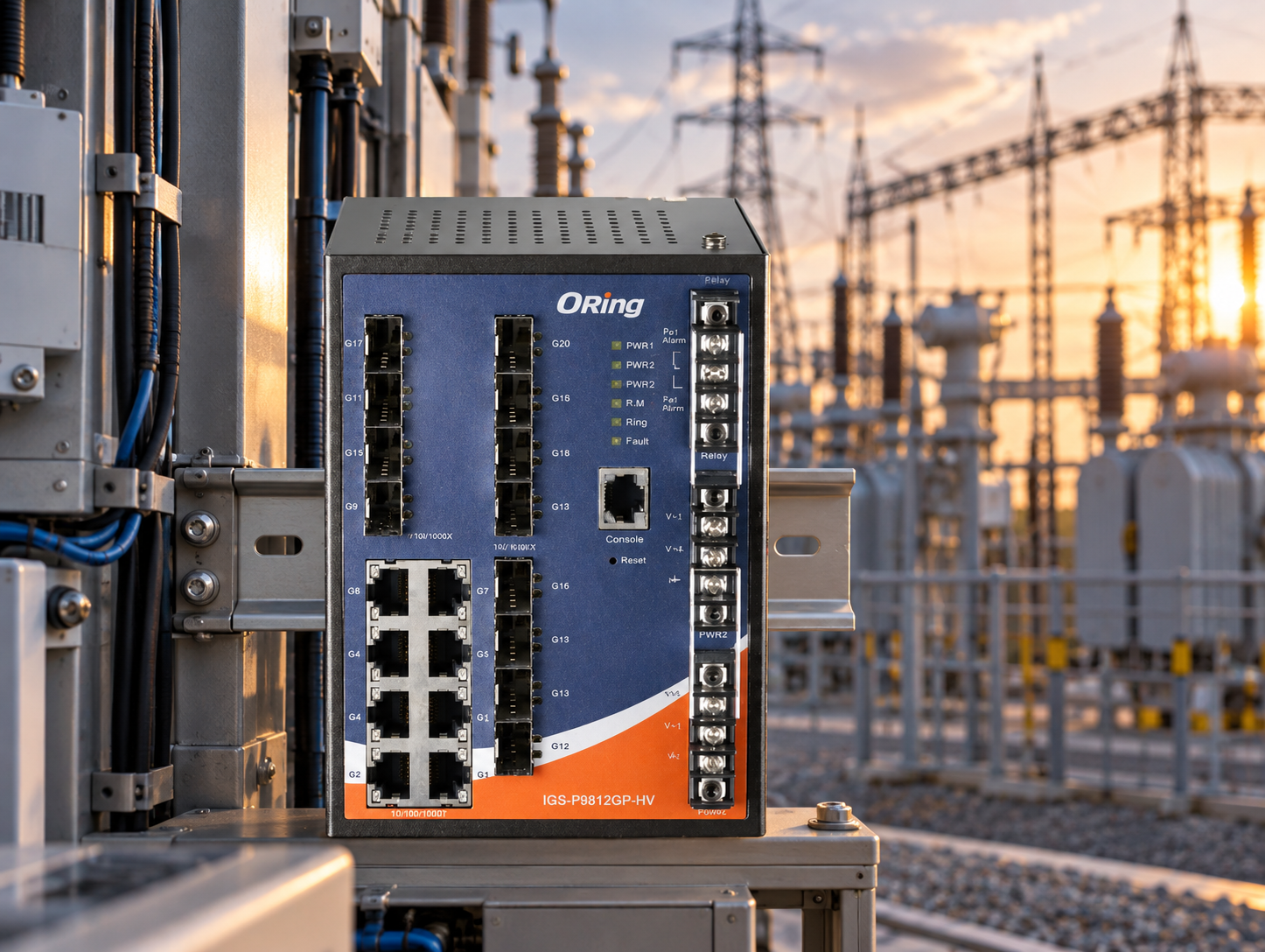
| Design Area | Typical Commercial-Grade | Industrial-Grade Approach |
|---|---|---|
| Operating environment | Climate-controlled indoor use | Designed for wider environmental variation; exact range varies by model |
| Power input | Often single AC adapter/input | Industrial DC input and redundant feeds are common |
| Mounting | Desktop or rack | DIN-rail, panel, rack or application-specific mounting |
| Thermal design | May use fans | Fanless designs common to reduce moving parts |
| EMC / surge tolerance | Office/IT environment assumptions | Designed and tested for industrial electrical environments |
| Redundancy | Basic STP/RSTP or none | Industrial ring and standard redundancy options by model |
| Diagnostics | Basic web/SNMP depending on model | Industrial alarms, event logging and OT-oriented monitoring |
| Certifications | General IT safety/EMC | Application-specific: EN 50155, IEC 61850-3, NEMA TS2 |
3. Why Temperature and Vibration Matter
Industrial devices are often installed next to motors, drives, power equipment, production machinery, outdoor cabinets, or moving vehicles. These locations can experience temperature swings and mechanical stress that are unusual in an office. If the switch is outside its rated environment, intermittent failures may appear as packet loss, link resets, power cycling, or complete loss of communications.
4. Redundant Power and Ring Recovery: What Downtime Actually Costs
Many OT networks carry traffic that affects production, monitoring, safety, or Remote control. A single failure can stop a line or blind operators to field conditions. Redundant power inputs reduce the risk of a switch going offline because one feed fails. Network redundancy creates an alternate data path if a cable or node is lost.
ORing's portfolio includes industrial ring technologies such as O-Ring/O-Chain on selected models, as well as standard redundancy protocols on managed products. The exact protocol and recovery time must be confirmed by series.
5. Certifications You Cannot Skip
IEC 61850-3
Used in power-substation environments where networking equipment must tolerate demanding EMC and environmental conditions. Treat certification as a model-level requirement.
EN 50155
Relevant to electronic equipment used on rolling stock. It addresses railway operating conditions including temperature, shock and vibration. Verify the applicable class and the exact product certificate.
NEMA TS2
Commonly referenced in traffic-control deployments. Verify when switches are placed in roadside or intersection control cabinets.
IEC 62443-4-2
Defines technical security requirements for industrial automation and control system components. Important where OT cybersecurity is part of the procurement specification.
6. When a Commercial Switch Is Acceptable
A commercial switch can be perfectly reasonable in an office, lab, server room, or other climate-controlled environment where downtime is low-impact and the switch is not exposed to industrial electrical or mechanical stress. Using industrial hardware everywhere is not automatically better architecture.
The decision should be based on consequence of failure, operating environment, lifecycle expectations, and required network functions.
7. A Procurement Checklist
- Confirm the actual operating and storage temperature requirements
- Document input-voltage range, redundant-power needs and alarm contacts
- Define the required recovery topology and acceptable interruption time
- List vibration, shock, EMC, surge and enclosure requirements
- Specify certifications by application and verify them at model level
- Confirm VLAN, QoS, routing, SNMP, syslog and access-control requirements
- Compare total operational risk — not only purchase price