
Migrating from Fieldbus to Single Pair Ethernet: A Practical Guide
Migrating from fieldbus to Single Pair Ethernet (SPE) is not a rip-and-replace exercise. The most practical projects begin by identifying which field devices benefit from native Ethernet, which wiring can be reused or repurposed, where protocol conversion remains necessary, and where an SPE switch should sit between the field layer and the existing plant Ethernet network.
1. Why Plants Are Moving from Fieldbus to SPE
Traditional fieldbus and analog systems were designed for reliable control with limited data requirements. Modern plants increasingly want asset diagnostics, remote configuration, condition monitoring, security visibility and easier integration with edge and cloud systems. SPE can extend the Ethernet protocol model closer to sensors and instruments while reducing copper compared with multi-pair Ethernet.
That does not make existing fieldbus obsolete overnight. Installed PLCs, remote I/O and instruments may have long service lives. A phased migration lets operators add Ethernet where it creates measurable value without forcing a full shutdown.
2. What You Keep and What You Replace
| Existing Layer | Typical Migration Approach | What Can Often Stay | What May Change |
|---|---|---|---|
| 4–20 mA instruments | Keep on existing I/O or migrate selectively | PLC/DCS I/O and field wiring where still fit for purpose | Selected instruments, remote I/O or gateways |
| HART | Retain HART where process instrumentation depends on it; add Ethernet gateways or SPE in new zones | Installed instruments and control logic | Asset-access path and new field devices |
| PROFIBUS | Use gateways or phased replacement by Ethernet-capable devices | PLC logic and field devices that remain supported | Network segments, couplers and future devices |
| Modbus RTU / serial | Bridge through serial device servers or gateways before replacing endpoints | Serial instruments and applications | Transport layer and edge connectivity |
3. Cabling: Reusing Existing Two-Wire Runs
One of SPE's most attractive ideas is the potential to use a single balanced pair over long distances. But 'two wires' is not enough information to approve reuse. Cable impedance, conductor size, shielding, connector system, installation environment and link budget all matter.
For 10BASE-T1L, the target link can reach up to 1,000 meters under the standard's channel assumptions. A brownfield migration should therefore test the installed cable rather than assume it complies because the conductor count matches.
4. Where the SPE Switch Sits in the Architecture
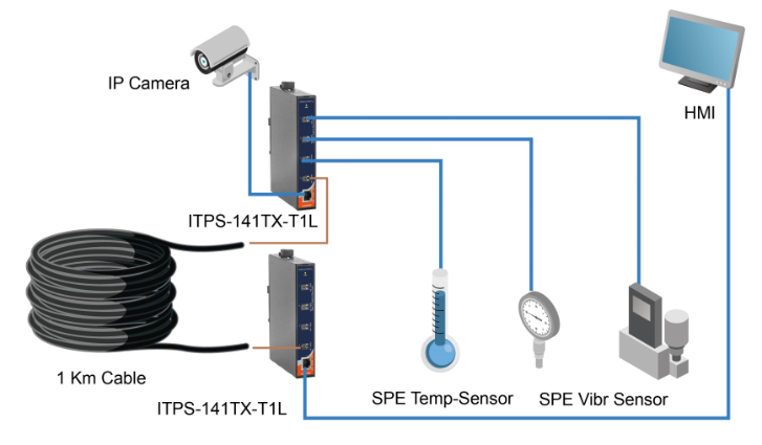
Typical architecture:
Field devices → 10BASE-T1L single-pair links → SPE Switch → Fast/Gigabit Ethernet uplink → PLC / edge controller → Plant backbone / SCADA
ORing's ITPS-141TX-T1L provides four 10BASE-T1L ports and one Fast Ethernet uplink, illustrating this boundary between field-level SPE and conventional Ethernet. It also supports PoDL on the SPE ports, subject to system power design.
5. A Phased Migration Plan
Phase 1: Pilot One Area
Choose a non-critical or not-well-instrumented area with a clear business case, such as additional diagnostics or reduction in cable complexity. Document baseline network behavior before the change.
Phase 2: Expand to One Machine or Production Line
After the pilot is stable, standardize the cable, connector, power, addressing and monitoring approach. Train maintenance personnel and capture configuration templates. Keep the existing fieldbus boundary where replacement adds little value.
Phase 3: Scale Across the Plant
Use the validated architecture as a repeatable building block. At this stage, VLANs, IP address planning, cybersecurity zones, spare port capacity and central monitoring become important as the number of Ethernet-connected field devices increases.
6. Common Pitfalls
Assuming all two-wire cable is suitable
Cable reuse is a test result, not a visual judgment. Verify the installed channel against the required SPE PHY specification.
Ignoring the PoDL power budget
If the same pair powers the endpoint, calculate per-device power, voltage drop and total switch power budget. Leave engineering margin instead of designing to the theoretical maximum.
Replacing stable fieldbus just because Ethernet is newer
Migration should solve a specific problem: data access, diagnostics, maintenance, integration, or lifecycle risk. Retain proven segments if replacement creates cost without operational benefit.
Treating hazardous-area requirements as a cable issue only
Hazardous-area deployments require system-level engineering. Do not claim intrinsic safety for an SPE design unless the complete device, power and installation architecture is certified for the intended zone.
7. Migration Checklist
- Inventory field devices, protocols, cable types and link distances
- Identify the business reason for migrating each segment
- Choose the required SPE PHY and verify endpoint compatibility
- Test reusable cable and define approved connector practices
- Place the SPE switch at a clear boundary between field links and plant Ethernet
- Calculate PoDL requirements where power over the pair is used
- Plan IP addressing, VLANs, cybersecurity zones and monitoring before scaling
- Pilot first, document results, then standardize